DCA Denies Records Request on ICE Communications
Jersey Signal Project seeks transparency as state agency cites ‘overbroad’ claim, raising questions about public oversight and interagency coordination.
With the Garden State still reeling from US Immigration and Customs Enforcement’s (ICE) latest surge, tense negotiations with the New Jersey Department of Community Affairs (DCA) have broken down after the agency denied a records request from Jersey Signal Project. The independent news outlet is seeking communications between state officials and federal immigration enforcement agencies, records which could either condemn or exonerate agencies accused by many of releasing sensitive data to ICE over the course of the past year. In an official statement, the DCA accused the request of being both “overbroad” and improper under the Open Public Records Act (OPRA).
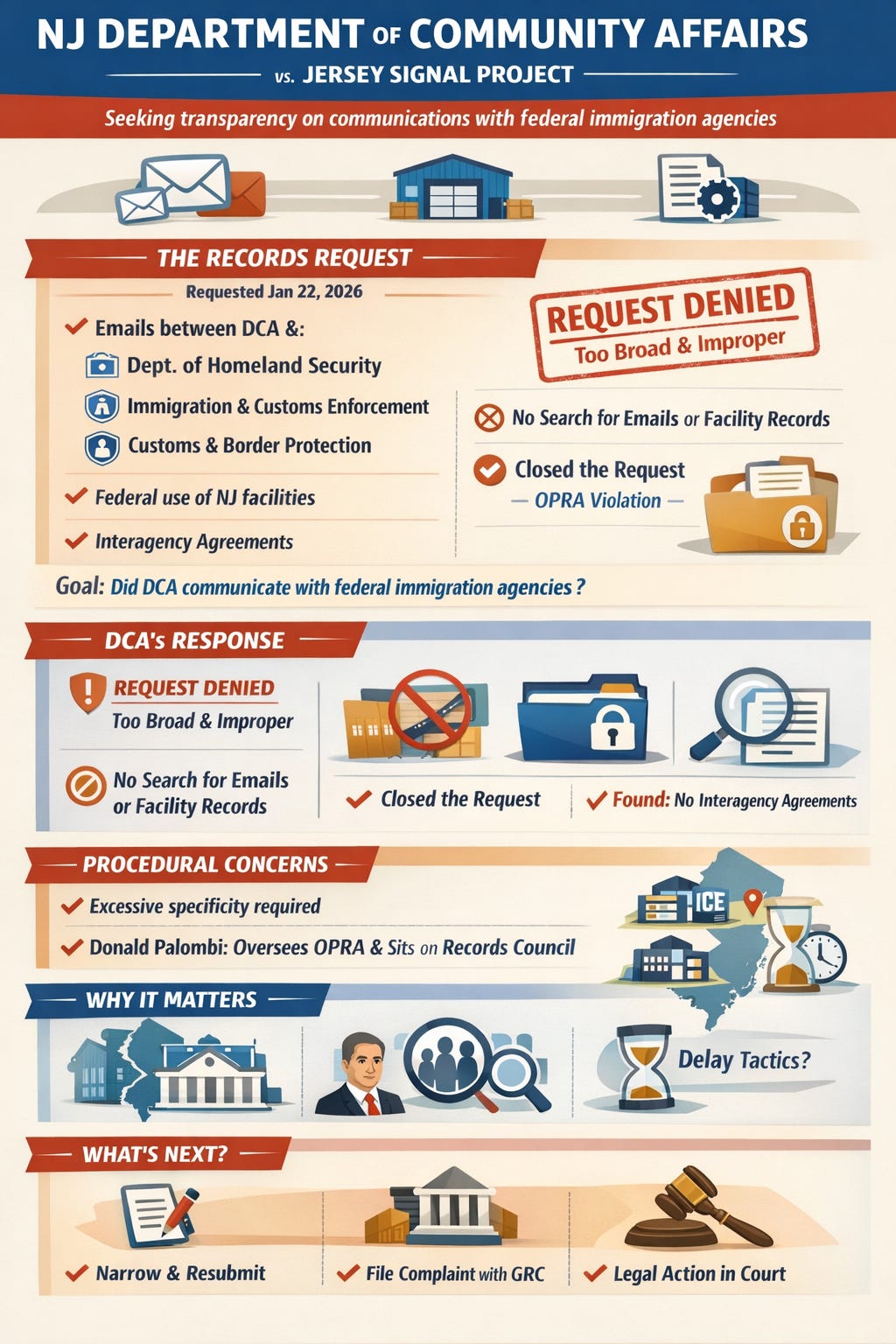
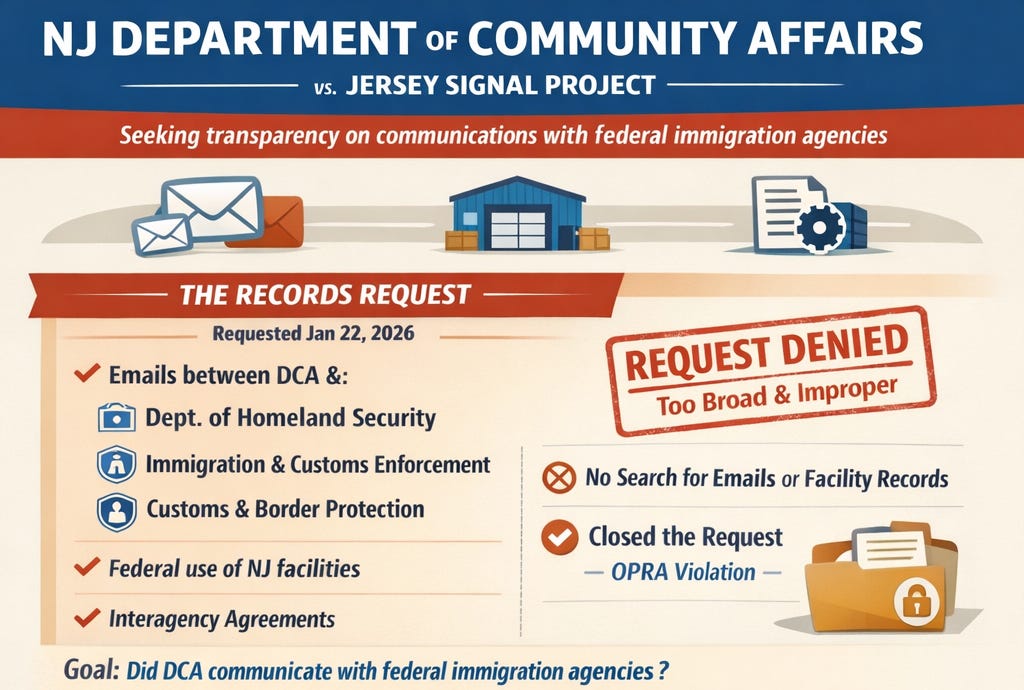
Based upon internal documents obtained from a confidential source, on January 22, 2026, Jersey Signal Project submitted a request seeking:
Emails between DCA officials and representatives of the U.S. Department of Homeland Security, U.S. Immigration and Customs Enforcement, and U.S. Customs and Border Protection
Records relating to potential federal use, leasing, inspection, approval, or coordination involving industrial, warehouse, or logistics facilities in New Jersey
Any memoranda of understanding or interagency agreements between DCA and those agencies
The request covered a defined three-year period: January 1, 2023 through January 20, 2026. It specified email domains such as “@dhs.gov,” “@ice.dhs.gov,” and “@cbp.dhs.gov,” and requested that any redactions cite the statutory exemption relied upon, as required by NJ OPRA.
Refusals, Denials, and a Closed Request
In a written response, Chief Regulatory Officer Donald Palombi denied the first two portions of the request in full, declining to address or attempt to fulfill any part of those portions. In a rare move, the agency also declined to ask Jersey Signal Project to narrow the request so that it could be partially fulfilled. The agency cited appellate decisions holding that OPRA does not authorize “blanket requests” or open-ended searches of agency files and requires requesters to identify records with reasonable clarity, including specific correspondents when seeking emails, but it remains to be seen whether those arguments are likely to succeed in court.
The third portion of the request, which sought memoranda of understanding or interagency agreements, was answered differently. DCA stated it conducted a search and found no responsive documents. In some circumstances, agencies can be compelled to demonstrate that the search was actually conducted.
At no point did the agency assert that the requested communications were exempt from disclosure. Instead, it declined to conduct a search, stating that the request was too broad as written.
The email from Palombi states that the request has now been closed, something that NJ OPRA does not permit the agency to do, opening the door to a Government Records Council denial of access complaint.
Publicly available records show Donald Palombi has served as the Department of Community Affairs’ designee to the Government Records Council, the body that hears OPRA disputes. While there is no published GRC decision clearly naming Palombi personally as the custodian in a denial complaint, attorneys from his office have appeared in published GRC matters representing agencies. His dual roles, both overseeing OPRA responses at DCA and participating in the body that hears disputes, highlight why stakeholders are paying close attention to how the department handles transparency requests.
(Based on a review of GRC meeting minutes and published decisions.)
NJ DCA and ICE: Have They or Haven’t They?
The request asked a direct and limited question: Has DCA communicated with federal immigration agencies regarding industrial, warehouse, or logistics facilities in New Jersey during a specific three-year period? With new ICE facilities proposed in Roxbury, Roseland, and other locations across the state, the question is a timely one.
If such communications occurred as part of routine intergovernmental coordination, that would be a straightforward matter of record.
If no such communications occurred, a search would confirm that.
Rather than put the matter to rest, the DCA’s decision reframes the issue as a procedural dispute over specificity.
A Pattern of Procedural Denials
Palombi, who serves as DCA’s Chief Regulatory Officer and oversees OPRA responses for the department, has previously been involved in disputes over records access in which requests were denied as overbroad or procedurally deficient rather than addressed on the merits. In several instances reviewed by Jersey Signal Project, requesters were required to substantially narrow or reframe their submissions before any search was conducted. Notably, Jersey Signal Project was offered no such option.
While agencies are entitled to require reasonable specificity under OPRA, critics argue that repeated reliance on “overbroad” determinations can function as a gatekeeping mechanism, particularly when the records sought concern politically sensitive topics.
An unscrupulous agency could for example issue a bad faith records access denial, gambling on the likelihood that the complainant would lack the staff and resources to fight the issue via the Government Records Council (GRC).
In a similar scenario, an agency wishing to avoid disclosing records could use the GRC as a delaying tactic, so that any records released are several months and dozens of news-cycles down the road. Whether this latest denial reflects a good-faith application of OPRA or an overly restrictive interpretation of the statute is likely to become a matter of further scrutiny.
Artificial Barriers to Oversight and Transparency
Under OPRA, members of the public are not required to know the precise identity of every employee who may have participated in communications before requesting records. Requiring a requester to pre-identify individual senders or recipients can create a practical barrier to oversight, particularly when the existence of such communications is itself the subject of inquiry.
By denying the request as overbroad rather than conducting a search and asserting specific exemptions if necessary, DCA has shifted the story from one about interagency coordination to one about access to public records.
DCA could have made this a simple matter of clarification or compliance. Instead, the denial raises broader questions about how the agency handles requests for records related to federal immigration enforcement and whether procedural objections are being used to avoid disclosure.
What Happens Next
Jersey Signal Project is evaluating whether to narrow and resubmit the request or to pursue administrative remedies through the Government Records Council or the courts.
If the state is coordinating with federal immigration enforcement agencies regarding facility use or regulatory oversight, the public has a right to understand the scope of that coordination.
And if it is not, transparency would be the simplest way to demonstrate that.