
Operation Salt Lamp: Powerful Tools for Researchers and Journalists
A Swiss Army Knife for the Digital Guerilla
In the modern landscape of independent journalism, information isn’t just power, it’s a moving target. Data is uploaded, indexed, and retracted in a matter of hours. By the time a mainstream newsroom assigns a story, the digital breadcrumbs are often swept away.
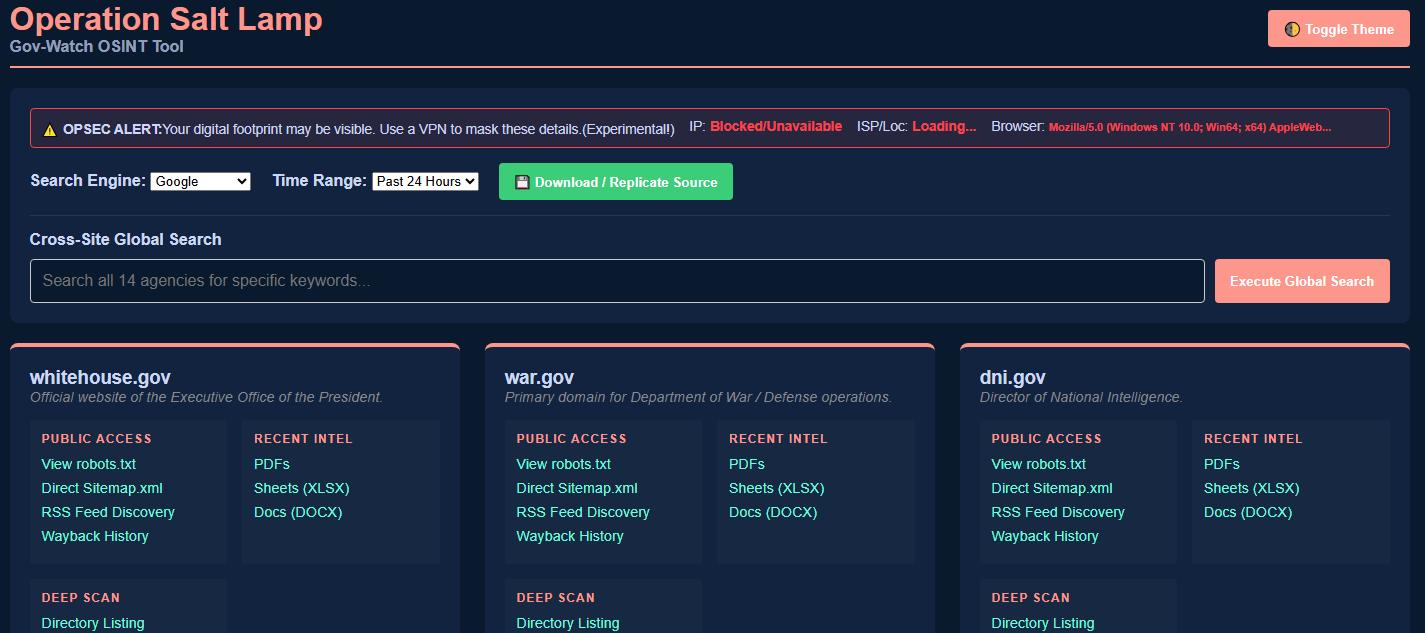
To bridge this gap, the Jersey Signal Project is proud to release Operation Salt Lamp, a lightweight, browser-based OSINT (Open Source Intelligence) dashboard designed specifically for researchers, whistleblowers, and independent investigators.
What is Operation Salt Lamp?
At its core, Salt Lamp is a curated command center. It targets 14 major U.S. government agencies, from the CIA and NSA to the IRS and NASA, and provides a streamlined interface to “dork” their public-facing servers.
We built this because the barrier to entry for digital investigation is often the complexity of the tools themselves. Salt Lamp removes that barrier. It is a single HTML file. No database, no subscriptions, and no middleman.
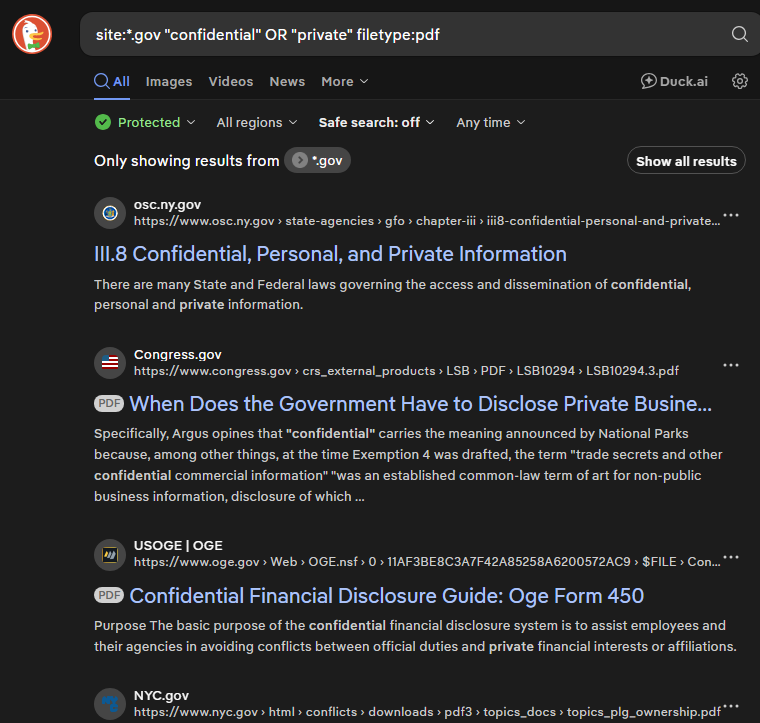
Dorking (n.): The practice of using advanced search engine operators to uncover "hidden-in-plain-sight" information. By leveraging specialized syntax like
filetype:,site:, andintitle:, researchers can bypass standard search results to pinpoint misconfigured servers, accidental document leaks, and sensitive data that hasn't been properly indexed for public view.
Key Features for the Modern Hunter
The Global Dragnet: Search all 14 agencies simultaneously for keywords like “memo,” “confidential,” or “unclassified” with a single click.
Time-Sensitive Intel: Use the built-in temporal filters to find documents uploaded in the last 24 hours, the “Golden Hour” where accidental leaks are most likely to be found.
Deep Scan Capabilities: Beyond just finding PDFs, Salt Lamp looks for “Metadata Fingerprints,” internal author names and office IDs buried in document properties, and directory listings that reveal the architecture of government servers.
Zero-Footprint Architecture: No installation, no dependencies, and no cookies. Because it runs as a standalone client-side file, your search history and investigation parameters aren’t tracked by a third-party server.
Engine Agnostic Intelligence: Switch between Google, Bing, DuckDuckGo, and Yandex on the fly. Different indexers see different things; Salt Lamp lets you cross-reference their “blind spots” without retyping your queries.
Infrastructure “Leak” Detection: Pre-configured dorks specifically designed to hunt for
robots.txtandsitemap.xmlfiles, revealing the directories that government admins are actively trying to keep out of public view.
The Power of the Public Domain
The most important feature of Operation Salt Lamp isn’t a button or a dork, it’s the license.
This project is released under CC0 1.0 Universal (Public Domain). It belongs to the people. We didn’t just make the code “open”; we made it yours. You can download the source, open it in any text editor, and completely rewrite it.
In fact, we highly encourage it! Think you can do better? Please do. Data feed integrations, image searching, inter-operability and other data processing suites, these are all improvements you or your organization could bring to the table.
We want you to tinker with it:
Change the Targets: Swap out federal agencies for your local school board or city council.
Add New Dorks: If you find a new string that uncovers hidden Excel sheets, bake it into the code.
Replicate & Reshare: Host it yourself, send it to a colleague, or keep it on a thumb drive for offline research.
What Can You Find?
In testing this current version, we’ve already seen its potential. By filtering for the “Past 24 Hours” and targeting “Sensitive Strings,” researchers have uncovered internal meeting agendas, unredacted contact lists, and server subdomains that were never meant for the public eye.
Salt Lamp doesn’t hack; it simply asks the right questions of the indexers that are already watching these agencies.
Join the Project
Operation Salt Lamp is an invitation. It’s a call to the citizen-journalist to move beyond the headlines and look at the source material.
Download the code, explore the interface, and start hunting. The light is on.