
The Roxbury Reckoning: NJ Challenges the Limits of Federal Power
Why the Supremacy Clause isn't a "Blank Check" for the Federal Government to Bypass Local Safety and Environmental Laws
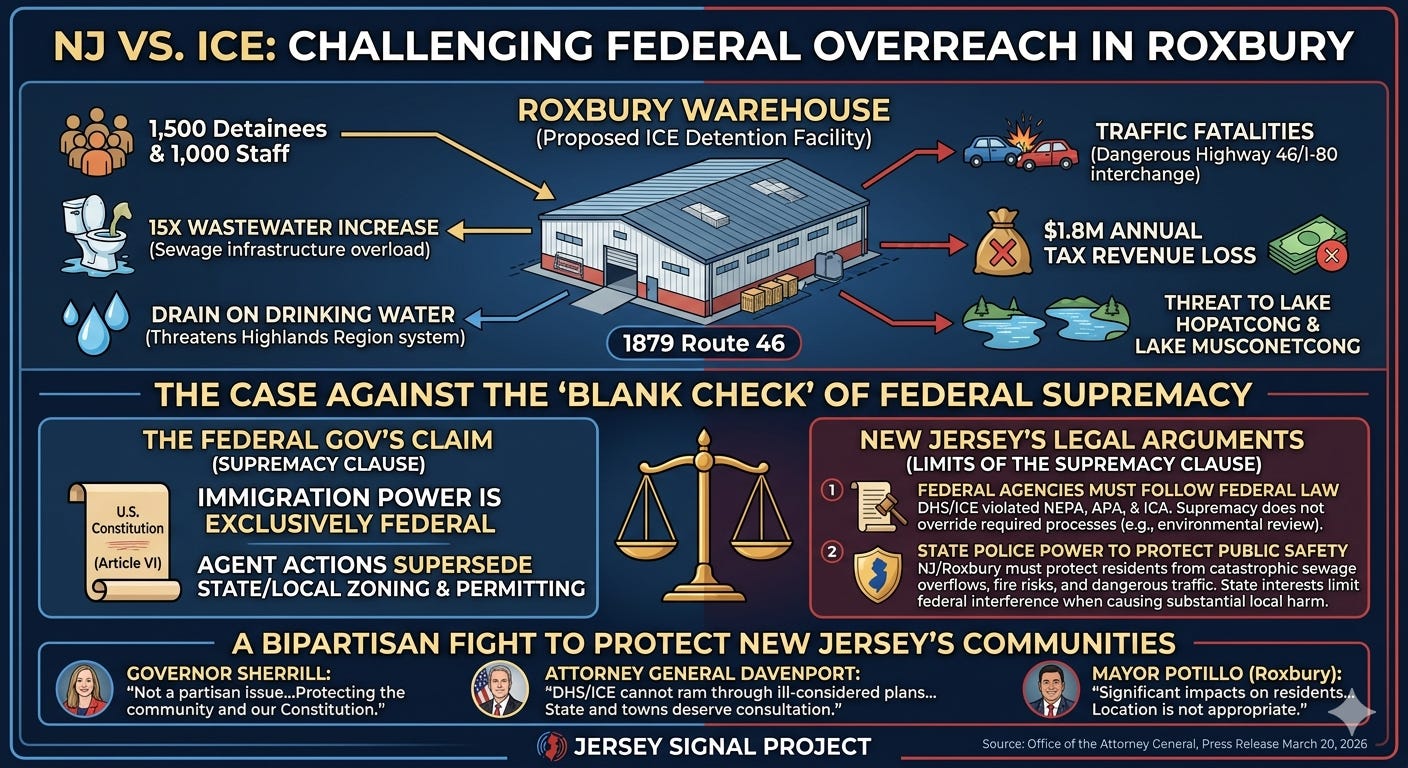
In a rare display of bipartisan unity, New Jersey Governor Mikie Sherrill and Attorney General Jennifer Davenport joined forces with local Republican leaders in Roxbury Township this week to file a federal lawsuit against the Department of Homeland Security (DHS) and Immigration and Customs Enforcement (ICE).
The legal challenge aims to halt the federal government’s plan to convert a vacant warehouse at 1879 Route 46 into a mass detention facility capable of holding 1,500 detainees. While the headlines focus on the environmental risks to Lake Hopatcong and the strain on local sewage systems, the case touches on a profound constitutional question: Does federal authority over immigration allow the government to ignore state and local laws entirely?
The Roxbury Standoff
The controversy began when state and local officials reportedly learned of the federal government’s purchase of the Roxbury warehouse through a newspaper article rather than official channels. The facility, a concrete structure currently equipped with only four toilets, is slated to house 1,500 detainees and 1,000 staff members.
According to the complaint, the conversion would increase wastewater output by 15 times the current approved limit, threatening the Musconetcong and Hopatcong watersheds. “This is not a partisan issue,” Governor Sherrill stated. “This facility will overburden local services and infrastructure... we are joining with Roxbury to protect the community and our Constitution.”
The Legal Battleground: The Supremacy Clause
At the heart of this conflict is a tension as old as the Republic: the Supremacy Clause of the U.S. Constitution (Article VI, Clause 2).
The Supremacy Clause establishes that federal law is the “supreme Law of the Land.” In the context of immigration, a field the Supreme Court has long ruled is a near-exclusive federal Rappaport, the federal government often argues that it has a “blank check” to operate without interference from state zoning boards or environmental departments.
However, the New Jersey lawsuit argues that there are clear, enforceable limits to this supremacy.
Procedural vs. Substantive Power
The Supremacy Clause prevents states from blocking federal policy, but it does not exempt federal agencies from following federal procedural laws. The lawsuit alleges that ICE and DHS violated the Administrative Procedure Act (APA) and the National Environmental Policy Act (NEPA).
NEPA requires federal agencies to take a “hard look” at the environmental consequences of their actions. By failing to conduct an Environmental Impact Statement (EIS) regarding the massive increase in sewage and the potential depletion of the Highlands region’s drinking water, the state argues that the feds aren’t just ignoring Roxbury, they are ignoring Congress’s own mandates.
The Intergovernmental Cooperation Act (ICA)
The complaint also cites the Intergovernmental Cooperation Act, a federal statute that requires agencies to consult with state and local views when planning federal projects. The “Supremacy” of the federal government does not grant it the right to operate in total secrecy. By “ramming through a secretive purchase,” as AG Davenport put it, the state argues the federal government has overstepped its statutory boundaries.
The “Intergovernmental Immunity” Limit
While the federal government is generally immune from state regulation (intergovernmental immunity), that immunity is not absolute. When a federal project creates a significant “negative externality,” such as sewage overflowing into public streets or creating lethal traffic conditions on Highway 46, the state has a “police power” interest in protecting the safety of its citizens.
Court to Debate Limits of Federal Power
If ICE is allowed to bypass local infrastructure limits by simply claiming “federal supremacy,” it sets a precedent that the federal government can place any facility, no matter how dangerous or ill-suited, in any neighborhood without so much as a phone call to the Mayor.
“The federal government has not provided any details regarding expected traffic impacts,” the complaint notes, highlighting the 1,000 staff members expected to descend on an already dangerous interchange.
The U.S. District Court will now have to decide if the federal government’s power over the border is so supreme that it can legally burst the pipes of a small New Jersey town. For the residents of Roxbury, the answer isn’t just a matter of law, it’s a matter of basic community survival.