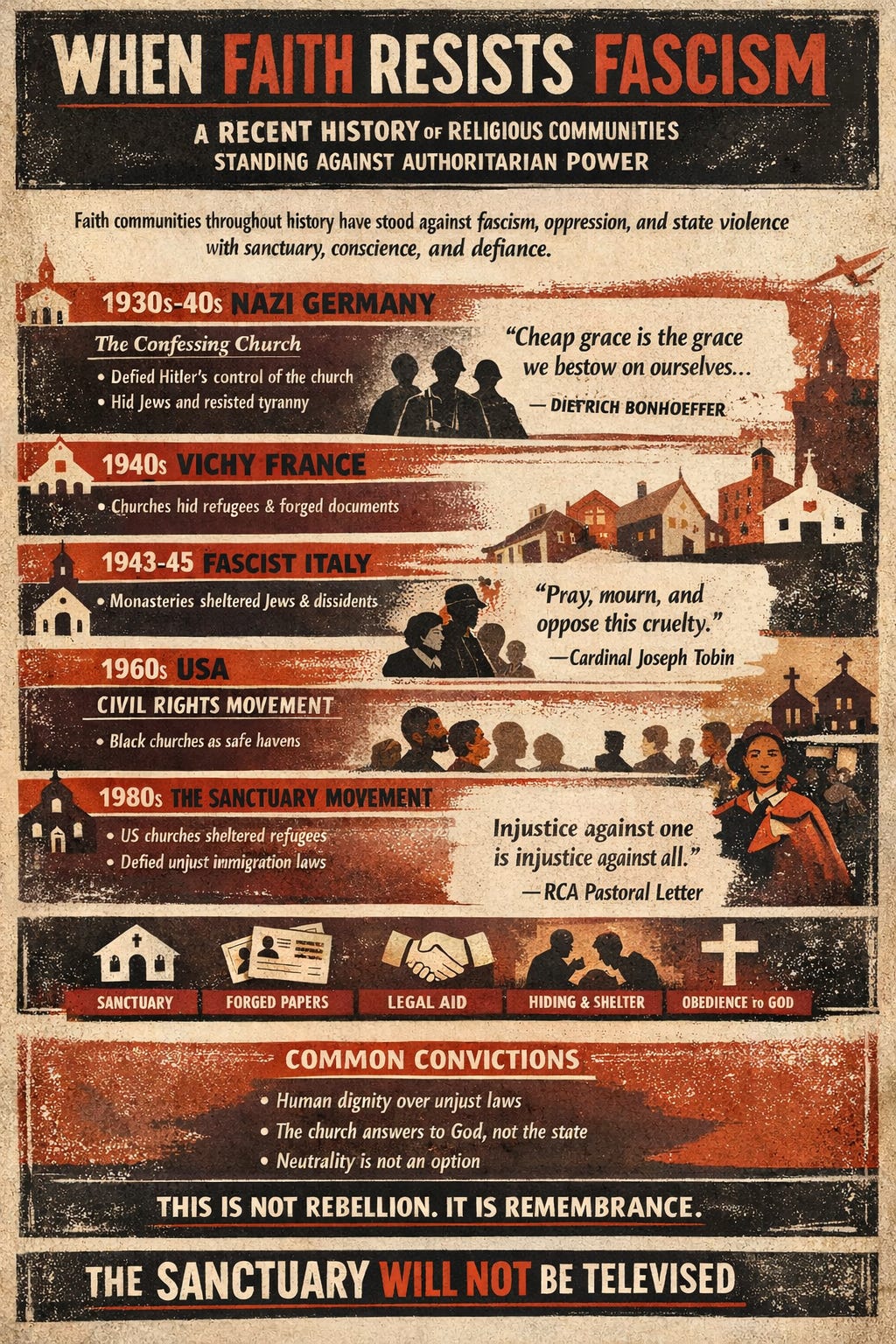
The Sanctuary Will Not Be Televised
New Jersey's Churches Quietly Gear Up to Shelter Refugees from ICE
A quiet revolution is unfolding in New Jersey’s churches—and it is happening deliberately out of sight.
It will not be televised. It will not be livestreamed. It will not announce itself with rallies or slogans. Instead, a quiet movement taking shape in prayer meetings, church basements, legal clinics, sanctuary conversations held behind closed doors, and sermons that no longer speak in abstractions.
Across New Jersey, faith communities are preparing themselves for moral resistance: to shelter refugees, to stand between families and state power, and to answer a demand that faith itself makes—whether or not anyone asked them to.

ICE Raids Hit Close to Home
A black SUV rolls to a stop. Men in body armor step out, faces hidden behind dark sunglasses. The engine keeps running. A father. A teenager. A student. People are taken quickly—before anyone can call a lawyer—and loaded back into the vehicle. Moments later, it is gone, headed toward one of several detention centers or discreet office parks in the region. This was Morristown earlier this month.
Across town, Washington’s Headquarters stands in stately antiquity. The churches where he worshipped, the homes where he and his staff gathered to plan resistance and independence, are still in use today. New Jersey has the revolution in its bones—resistance in its blood—and a long, intimate familiarity with displacement and refuge.
The Garden State has one of the largest immigrant populations in the country by percentage. As of 2024, nearly one in four New Jersey residents was born outside the United States. Some are newcomers; many have been here for years, even generations. Entire towns, school systems, and local economies depend on families who live with the daily anxiety of enforcement actions they cannot predict or control.
When raids occur, they do not land in the abstract. They go off like bombs in laundromats, construction sites, kitchens, and classrooms - taking victims seemingly at random to be seen years or months later, or perhaps never again. They land in congregations, a direct assault tearing out the threads of tightknit spiritual communities.
For these communities, ICE raids are not law and order, they are mines and mortars, which leave a gaping hole, they are a “truth that brings a pain that can’t be soothed.”

But the raids also hit close in a deeper sense. They are morally close.
Communities of faith in New Jersey carry long memories of occupation, displacement, and endurance. Through scripture, history, and lived inheritance, many congregations know what it means to be the stranger, the sojourner, the refugee. They recognize the pattern when family separation is normalized, when force becomes routine, and when entire communities are treated as suspect.
New Jersey’s churches are responding not because this is new, but because it is familiar.
(Article Continues Below)
There Was Never a Choice
It is tempting to say that institutions are “choosing sides.” That framing misses the point: for churches formed by scripture and confession, there was never a choice to make. Whereas modern followers don the title of Christian, the movement’s founding members knew themselves only as “followers of the way.” And when refugees are under fire, for adherents, there is no other way.
In late January, the Reformed Church in America named the moment plainly, describing immigration raids as a humanitarian crisis and a theological emergency. The denomination affirmed that “all people are created in the image of God… deserving of dignity, safety, and justice,” and insisted that belonging “extends across borders and legal categories.”
The letter went further, invoking the Belhar Confession, a powerful condemnation of Apartheid South Africa, to reject “any form of injustice, exclusion, or discrimination that marginalizes people due to race, ethnicity, language, or immigration status,” and reminding the church that Jesus himself fled state violence as a refugee.
For the RCA’s 50,000+ confessing members, this is not political alignment, it is a powerful call to live out their faith.
Whether individuals articulate it this way or not, what is happening inside New Jersey’s churches is a rejection of cheap grace—the grace that asks nothing, risks nothing, and protects nothing. In its place is what Nazi-resister Dietrich Bonhoeffer called costly grace: grace that compels action, that demands protection of the vulnerable, that refuses to separate faith from consequence.
(Article Continues Below)

Sanctuary Is Not a Metaphor
For many congregations, sanctuary is no longer symbolic language.
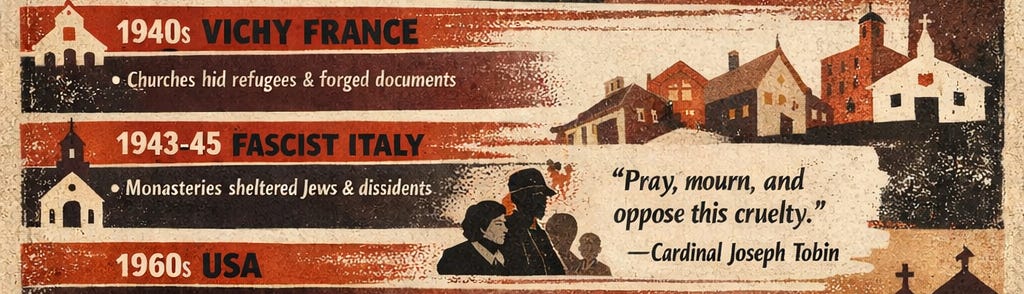
It means training volunteers to accompany families to court. It means hosting legal aid clinics. It means quietly coordinating housing, food, transportation, and emergency support.
And in some cases, it means preparing to physically shelter people when the state comes looking for them.
The RCA letter does not soften this responsibility. It calls churches to “offer tangible care, legal support, housing, food, community, for those directly affected,” and to “challenge the structures that create suffering,” insisting that “injustice against one is injustice against all.”
Far from current events, many students of history will recognize this as the current generation of the faithful inheriting the calling and responsibilities of their tradition.
A Reformed Tradition That Knows How to Resist
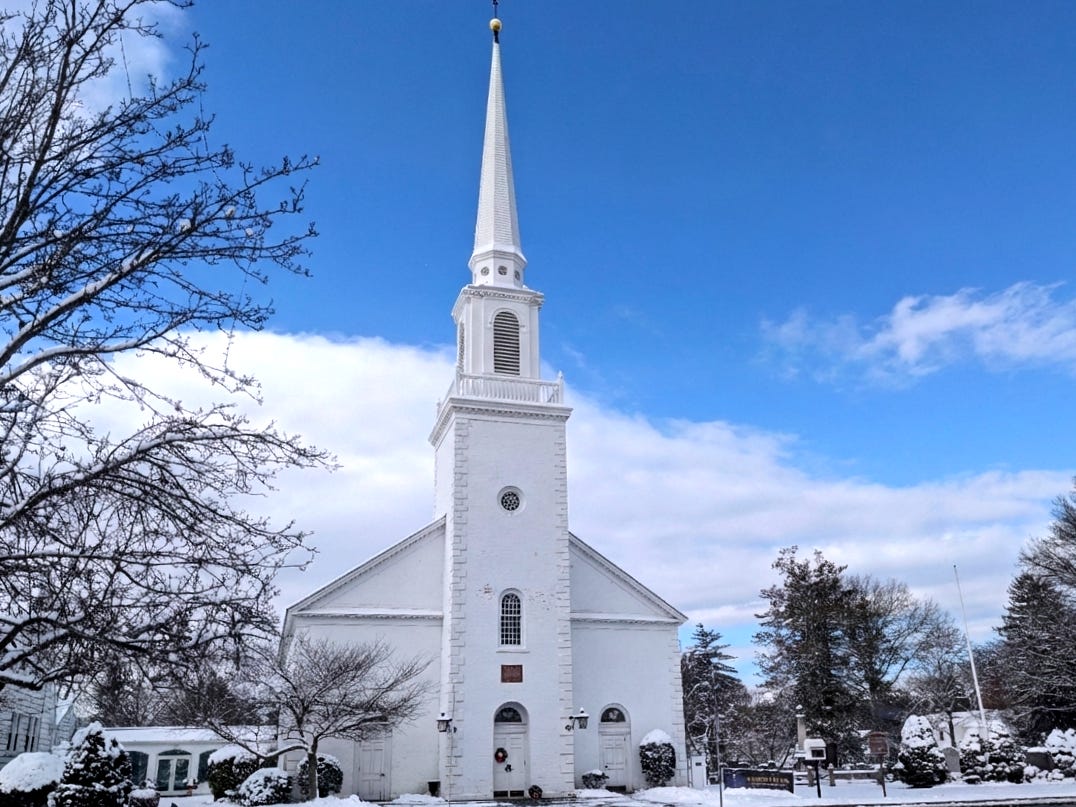
The Dutch Reformed tradition has been part of New Jersey for centuries—long before the Republic existed.
These were not court theologians or imperial clergy. They were farmers, tradespeople, and common folk. Their churches were built by communities that understood perseverance, self-governance, and moral independence. Some congregations in New Jersey predate the United States itself, carrying a memory that reaches back into the colonial era.
These are the kinds of communities that once raised liberty poles. The kinds of communities that recognize no head of the church but Jesus Christ.
A tradition formed this way does not take federal infringement lightly—especially when it arrives at the doorstep of the vulnerable
(Article Continues Below)
Why Some Clergy Use the Word “Occupation”
When pastors describe immigration enforcement as a federal occupation, they are not indulging in rhetoric. They are naming a lived experience: armed agents operating with limited transparency, sweeping through neighborhoods, detaining people based on appearance, language, or association.
For Black, Latino, Asian, Indigenous, immigrant, and mixed-status communities, this does not feel unprecedented. It echoes older clearly remembered harms. The RCA’s racial and ethnic councils named this continuity directly, linking present-day raids to histories of slavery, internment, forced removal, and family separation.
Viewed through this lens, resistance is not radical. It is responsible.
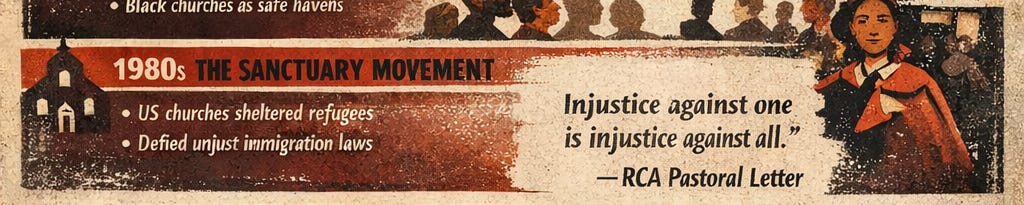
Resistance Without Violence
What is emerging in New Jersey’s churches is not a call to arms. It is a call to conscience.
The language coming from pulpits and pastoral letters emphasizes nonviolence, dignity, and moral clarity. It draws on scripture, confession, and historical memory to argue that obedience to God sometimes requires disobedience to unjust systems.

That argument has deep roots in Christian theology—and deep consequences when taken seriously. New Jersey’s churches are not asking whether this path will be controversial. They know it will be.
They are asking a harder question: what does faith require when law becomes detached from mercy?
History offers little grace to institutions that chose silence.
And across New Jersey, in sanctuaries both grand and modest, that lesson appears to be sinking in.
Thanks for reading, check out our powerful infographic: